
Recommendations for Increased Funding for Biking and Walking Infrastructure
This month we submitted a letter to the Chapel Hill Town Council with recommednations for increased funding to the annual Capital Improvements Fund. See below for our letter. We are seeking volunteers to share their experiences and reasons for biking and walking in the town at the next town council meeting in May. More detail to come, please indicate your interest (not committment!) via our Contact Us page.
Subject: Shift CHC recommendation to increase Infrastructure budget
Dear Mayor and Town Council,
On behalf of Shift Chapel Hill-Carrboro, I urge you to increase the annual Capital Improvements Fund (“CIF”) budget allocation to Infrastructure from $561,000 to $2 million. As explained below, this is a financially efficient means of advancing Chapel Hill’s affordability goals in this budget cycle.
Existing Infrastructure Budget
Chapel Hill does not have a regular budget allocation large enough to build (vs. design) any major piece of bike and pedestrian infrastructure. Starting in FY 2024, the Town started budgeting for approximately $400,000 per year for “Everywhere to Everywhere” greenways within the Capital Improvements Fund – largely financed through transfers from the General Fund. The money was not actually allocated in FY 2024 but has continued as a line item in subsequent budgets (see excerpt below). By default, it seems likely that approximately $400,000 will be allocated again to this line item in the forthcoming draft FY 2027 budget.
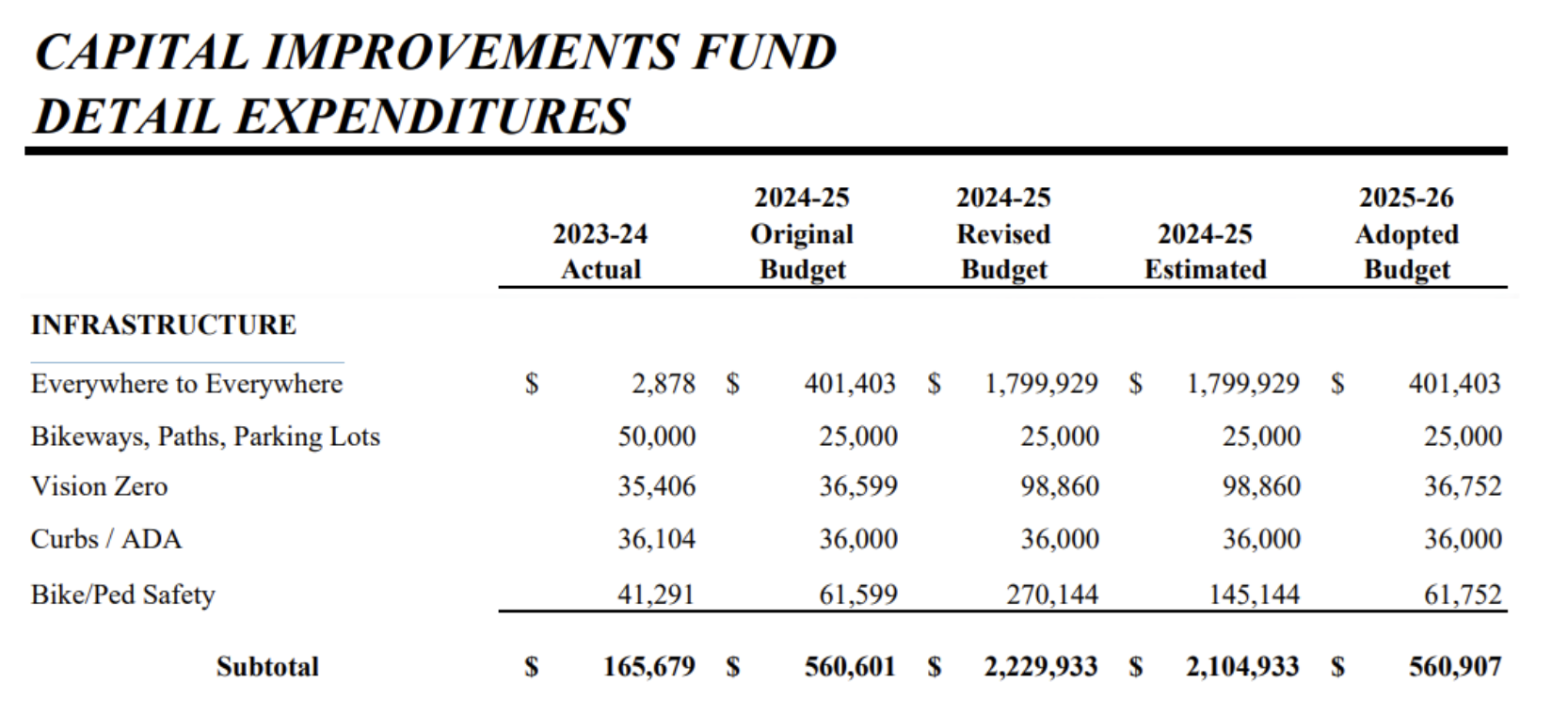
The original purpose of this line item was to fund greenway design so that the Town could have “shovel ready” projects for outside grant funding. The budget item is insufficient to meaningfully fund greenway construction, for which the Town currently relies on a combination of outside grants (e.g., TPO grants) and occasional local bond issuances. The Capital Improvement Fund’s larger “infrastructure” category, totaling $561,000 in FY 2026, mostly comprises the “Everywhere to Everywhere” line item but also includes other, relatively modest line items that tie to bike and pedestrian infrastructure and could be used for low cost “tactical urbanist” projects.
Meanwhile, according to OMG, design costs for a typical greenway segment average approximately $500k-600k. Construction costs vary considerably by project, averaging in the millions per mile.
Current Outcomes
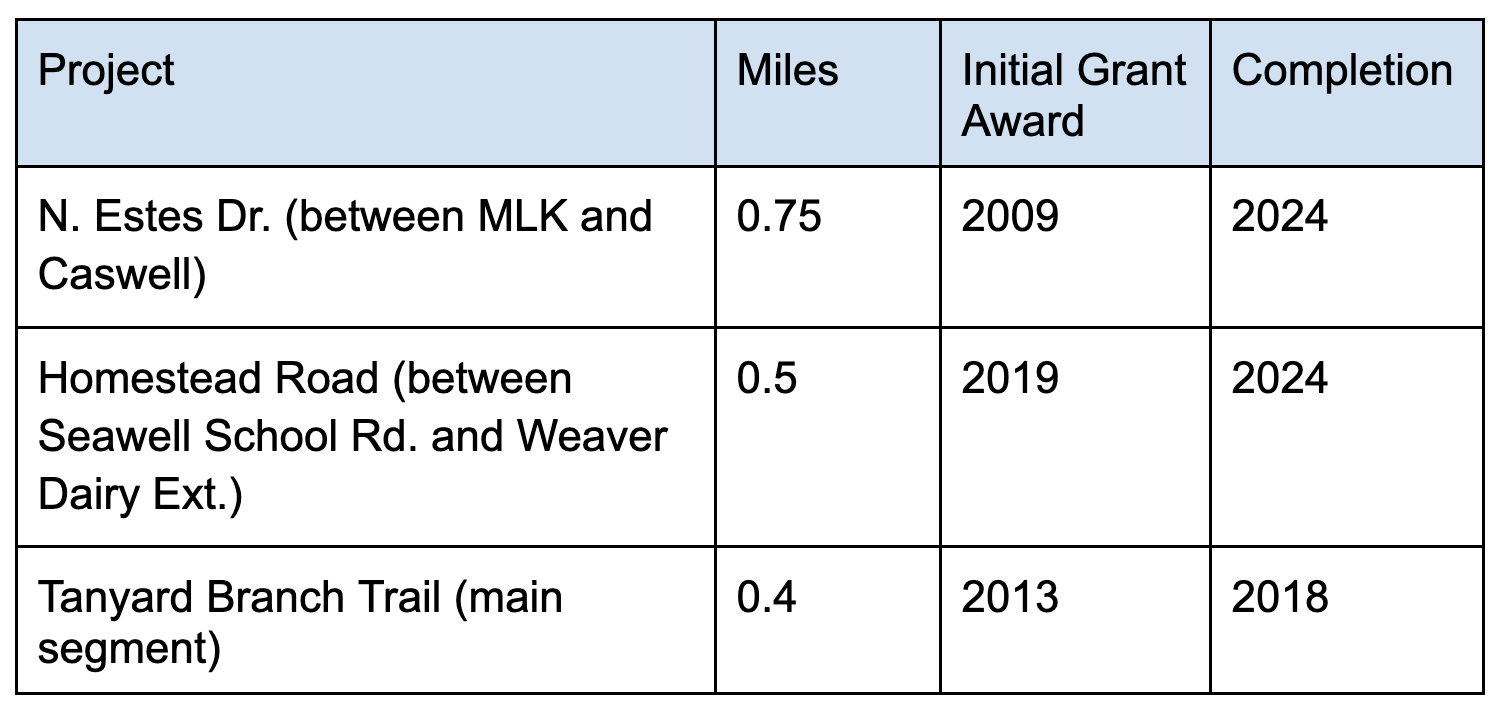
The lack of annual budget capacity contributes to slow and sporadic development of new bike/ped infrastructure. From 2015 to 2025, Chapel Hill constructed a total of 1.65 miles of new greenways and multi-use sidepaths. Each project relied on outside grant funding, with at least 5 years elapsing between initial grant award and project completion.
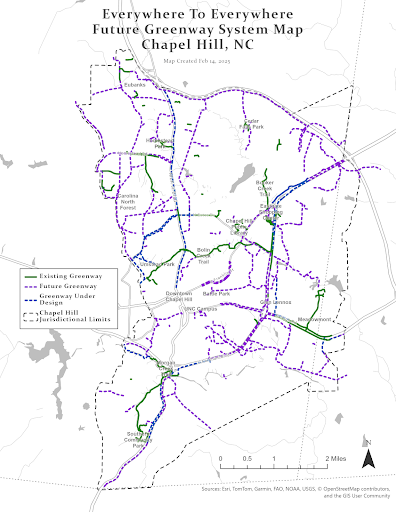
The map below, taken from the Town’s website, shows that the vast majority of Chapel Hill’s envisioned greenway system remains to be built. At the current pace, including projects in the pipeline, the envisioned greenway system would take more than a generation to complete – even assuming continued federal grants.
The slow pace of project delivery is a drag on affordability and other goals. Bike/ped infrastructure:
Enables households to reduce their own transportation spending. Transportation is the second-largest U.S. household expense after housing – costing the typical household about half as much as housing, and more than it spends on food or health care.
Stimulates private housing investment by making neighborhoods more livable and appealing, especially to younger generations.
Enables denser, lower-cost housing configurations by decreasing the amount of parking that, in the absence of bike/ped infrastructure, the market forces developers to build. The typical cost to build structured parking, not counting land cost, is approximately $25,000+ per spot (see here and here).
Provides well-understood co-benefits related to safety, accessibility, health, traffic mitigation, carbon reduction, and economic competitiveness.
To the extent Chapel Hill underfunds the Infrastructure budget, particularly at this early stage of infrastructure development, it will continue to forego these benefits.
Impact of Shift’s Recommendation
A $2 million annual CIF allocation to Infrastructure would be a game changer. A budget of this size would provide:
A reliable source of “local match” funds – currently a major constraint on how many grants OMG applies for;
Some capacity to not only design but actually construct a major piece of bike/ped infrastructure every couple years, and to implement a larger number of tactical urbanist measures; and
A realistic prospect of completing the Town’s envisioned greenway network within a generation.
Instead of devoting years of effort to planning and re-planning the same unfunded projects (e.g., Morgan Creek East), staff would spend proportionately less time planning and waiting and more time delivering projects.
Policy Justification
Dollar-for-dollar, bike/ped infrastructure is the most efficient affordability investment the Town can make. Most affordability programs are expensive, targeted, and capacity-limited. Bike/ped infrastructure is different: it’s a universal affordability investment with no marginal cost per user, no operating workforce, low maintenance costs, and no practical limit on uptake. It’s one of the only ways the Town can reduce household expenses at scale without creating an ongoing fiscal burden.
In doing so, Chapel Hill could begin to mitigate the current impact of high housing costs on local commuting patterns. According to the UNC Office of Institutional Research and Analysis, most UNC employees live outside Chapel Hill. The most powerful economic incentive the Town can provide to induce more UNC employees to live in Chapel Hill is enabling them to drop a car payment.
While the affordability argument for bike/ped infrastructure addresses one of the Town’s central challenges, bike/ped infrastructure also has myriad environmental, livability, and economic co-benefits listed briefly above – too many to elaborate on here. This helps explain why bike/ped infrastructure features so prominently in the Complete Community vision, which centers around not only affordability but also sustainability and economic competitiveness.
With a $2 million annual Infrastructure budget and periodic bond issuances, plus federal grants, we can exceed critical mass within 20 years – opening possibilities that seem unimaginable today.
Addressing Common Misconceptions
Two false assumptions may have contributed to the small size of the current Infrastructure budget. In the past, some may have believed that the Town’s ability to secure federal grants obviated the need to allocate more local funding to build out bike/ped infrastructure. Although Shift supports the Town’s aggressive pursuit of grants, a strategy of building only federally-subsidized greenways, at anticipated federal funding levels and timelines, could take another 30 years or more to build the additional 25 miles called for in the RAISE grant application – regardless of administration. The delay would cause an ongoing drag on affordability. In particular, gaps in the greenway system will limit the flow of capital to housing development and result in less dense, more expensive housing and needlessly high per-household transportation costs. It will also limit mobility for non-drivers, undermine Vision Zero, keep extra cars on the road, drag down the Town’s potential revenue growth, and contribute to carbon emissions.
Others may have doubted that residents would actually use bike/ped infrastructure to reduce their transportation expenses. This point of view has become outdated. Chapel Hill’s compactness enables typical travel distances (and topography) to be covered relatively quickly via e-bike, often within 10-15 minutes. The affordability benefits of more greenways will accrue to households that leverage them to live “car-lite,” even if not entirely car-free. Reducing a household’s car ownership from 2 to 1 or 3 to 2 – which is relatively more likely in cases where at least one adult works in town or remotely and money is tight – can save the equivalent of several months of rent or mortgage payments every year, even assuming moderate use of ride share services as backup transportation. Many residents will, as others already have, go car-lite. To foster a more affordable, green, and vibrant Town, let’s provide them the means and encouragement to safely do so.
Respectfully,
Jon Mitchell
President, Shift Chapel Hill-Carrboro